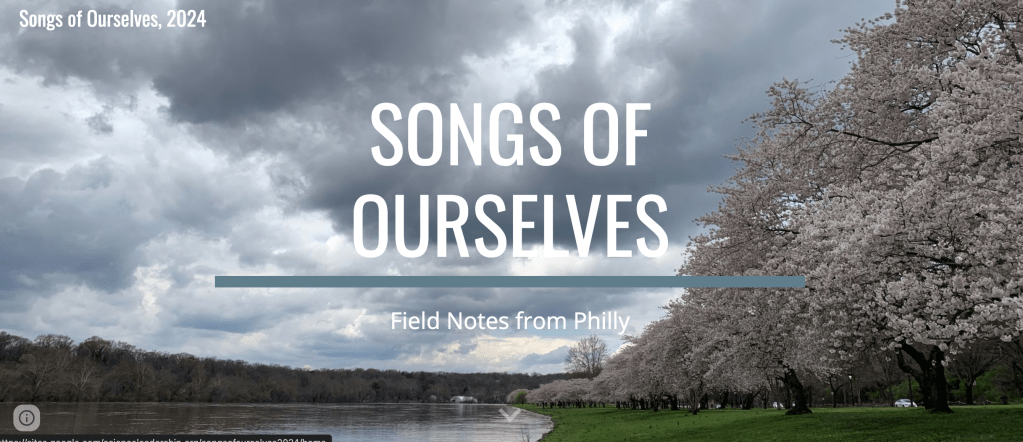
For the second year in a row my students spent the month of May writing, revising, and publishing Field Notes for our Songs of Ourselves unit. The final products remind me of the value of work that is simultaneously creative, personal, and analytical. In this unit, multiple students who are not always all in for school rose to the occasion and produced poignant, insightful writing to be shared with wider audiences.
This post is about teaching works by Walt Whitman and Claudia Rankine, which set the stage for the the Field Note writing process. I share these teaching vignettes with the goal of illustrating different, creative strategies that can be used to orient and engage students to texts that challenge them on different intellectual and emotional levels. Song of Myself and Citizen are clearly very different works. By placing them side-by-side and designing multiple activities along with a incorporating a range of reading strategies, students were able to make meaning and respond in ways that brought them into conversation with each of the authors.

To begin, students made observations about the image of Whitman from the original Song of Myself cover before sharing (on a slide of a shared slide deck,) an image of an artist who, in their opinion, changes the way people think. After this brief intro, we began by listening to a recording James Earl Jones reading Whitman’s work. I paused frequently, decoding words and sharing my thoughts about the text more than I normally would. My goal was to help them feel oriented and connected to a work that felt very foreign. For the first five sections, students were responsible for submitting an assignment with:
- Four different lines from each section
- Three things you notice
- Two questions you have
The next day I asked the class, “What is Walt Whitman about?” The question was intentionally broad and open. After speaking in groups and recording bullet points in their notebooks, people shared items from their lists with the whole class. I wrote on the board for them to add to their notes. This activity was a reminder of the value of sharing individual thoughts and insights to create a larger bank of shared knowledge. While I had been concerned about students comprehending Whitman’s writing, many were beyond simple comprehension and were deeply thinking about and connecting to what they were reading. Those that were struggling or feeling disconnected from the text got a big boost by hearing from others.
After doing more reading, pausing, and discussing, I assigned groups a Tableaux (Frozen Sculpture) photo activity. My goal was to get people on their feet, doing a creative activity as they continued discussing the text. Before setting groups off to work on the activity, I modeled the act of sculpting a Tableaux with a group of students in the front of the room, guiding groups to think about different levels, facial and hand gestures, and connections between different people.
Tableaux / Frozen Sculptures (with table groups):
- Choose four passages (1-3 lines) from the sections so far.
- For each of the four passages, stage a photo that adds to the meaning of or embodies the words.
- Put each passage and photo on a slide deck (four slides total) with the names of your group members
- Submit a link to the slide deck on the online discussion

The next day we had a good time looking through photos before reading Section 15 together. After some discussion of the section, I assigned a writing assignment:
With a partner or on your own (on a Google Doc) record descriptions of at least 20 unique people you see regularly in Philly. Use the repetitive style that Whitman uses in Section 15. Craft your piece carefully, choosing an order and a flow that will stand out to readers.
Once individuals and pairs submitted their docs I shared them into a whole class doc and had them add at least three lines from their own piece to the whole class piece. This led to an entertaining dramatic reading of the often overlooked people who are part of our daily lives.

The next week we switched to Rankine’s work. The class began with the question, “What is a microaggression?” on the screen. A smaller number of students were ready to offer their early thoughts while others have never heard this term before. After a short sharing of ideas, students watched a short video followed by a second video, accompanied by an article before choosing a quote to post, a response (at least 50 words), and a question for the class to an online Discussion. After posting, students responded to the questions or replies of at least three other people. This was a moment when an online discussion seemed to allow students to explore the topic more deeply. Students were asking interesting questions and there was a genuine exchange of ideas and experiences. The norms and habits built throughout the year mean that people do this thoughtfully, without attempting to call each other out. Instead, there were moments of interesting disagreement that was handled respectfully.
While Rankine’s work was more accessible for students, there is great benefit to reading it slowly, pausing regularly for groups and the whole class to discuss different meanings and aspects of what they are reading. Some of this happened out loud during class and some happened after students completed assignments and were ready to share their thoughts with others.
Below is an example of a reading assignment:
As you read, in your notebook write four quotes from the section. Also, in your notebook write a paragraph (50+ words) in response to one of the quotes. In your paragraph, you may consider the questions:
- What is going on in this section?
- What do you notice about the writing and the choices the author makes?
- What thoughts do you have in response to the quote?
- Any other responses to the section?
The next day, after a brief exchange of ideas from the previous night’s reading, students have a new Rankine assignment:
With your group, go to your assigned location and decide together how you are going to read sections II and III of Citizen. You can alternate reading passages out loud, designate one or two people to read out loud, read some sections silently and others out loud, or any other method that works for your group.
As you read, fill out your T chart in your notebook with at least six quotes and responses to each quote. Responses can include questions, connections, reflections, or any other insights.
The culminating activity at the end of the first week of reading Citizen was a Fishbowl Discussion. To begin preparing students sat in groups of 3-4, looking over their notes and assignments from the week. Together they recorded four quotes worthy of discussion, three questions to ask, and two larger ideas to share. The students recorded this prep work on index cards which, after 10-12 minutes were handed to their “fish.” The fish then sat in a circle in the middle of the room as their supporters were positioned behind them. The conversation began when I clicked play on my fake remote control. Fish then ran the show until I clicked pause. Then, people on the outside offered commentary about strengths of the discussion and gentle suggestions for improvement. Periodically I also paused the action so supporters could huddle with their fish and recommend additional things to be brought up in the discussion. At other times new people tag in as fish. At the end of the day, everyone was responsible for submitting a picture of the discussion notes in their notebooks. I encouraged those that were fish to copy the notes of someone that was outside the fishbowl.
The next week, when we returned to Whitman, after reading some sections together, I introduced our Living Like Whitman film assignment:
How would Walt Whitman live in our world today? What would Walt Whitman do?
Answer these questions by following these steps:
1) With your group, select any eight Whitman quotes that you would like to work with for your film. As you make your selections, begin to think about the theme, the sequence of scenes, and other aspects of your film.
2) Working together write a complete script on a doc. Scripts should have three columns: Quote | Action | Audio.
3) Show your complete script to a teacher for credit.
4) Begin filming. You can film with phones and figure out your group’s work flow.
5) Consolidate footage, edit, and post to the web.
6) Submit link to film and Artists’ Statement to our online Discussion.
My goals for this project were to have students engage with Whitman more deeply as they discussed his work in order to construct a script. Also, so much of Whitman’s work is about experience and being fully present in the world. My hope was that by leaving the classroom and filming out in the world, students were be able to be silly, maybe even more fully alive, as they experimented with interacting with the world around them in new ways. I used the script conferences as opportunities to ask them more about their understandings of the text while encouraging them to experiment with different styles of filmmaking.
The final products did not disappoint! Students had a great time viewing each others’ work. Here is one example and here is another.
After all of these activities, reading continues, interspersed with the early work of writing Field Notes for our Songs of Ourselves unit. I am proud to share this profound collection of writing.
 Mr J Block